
Milestone Electronics
2 Relay Controller 230V
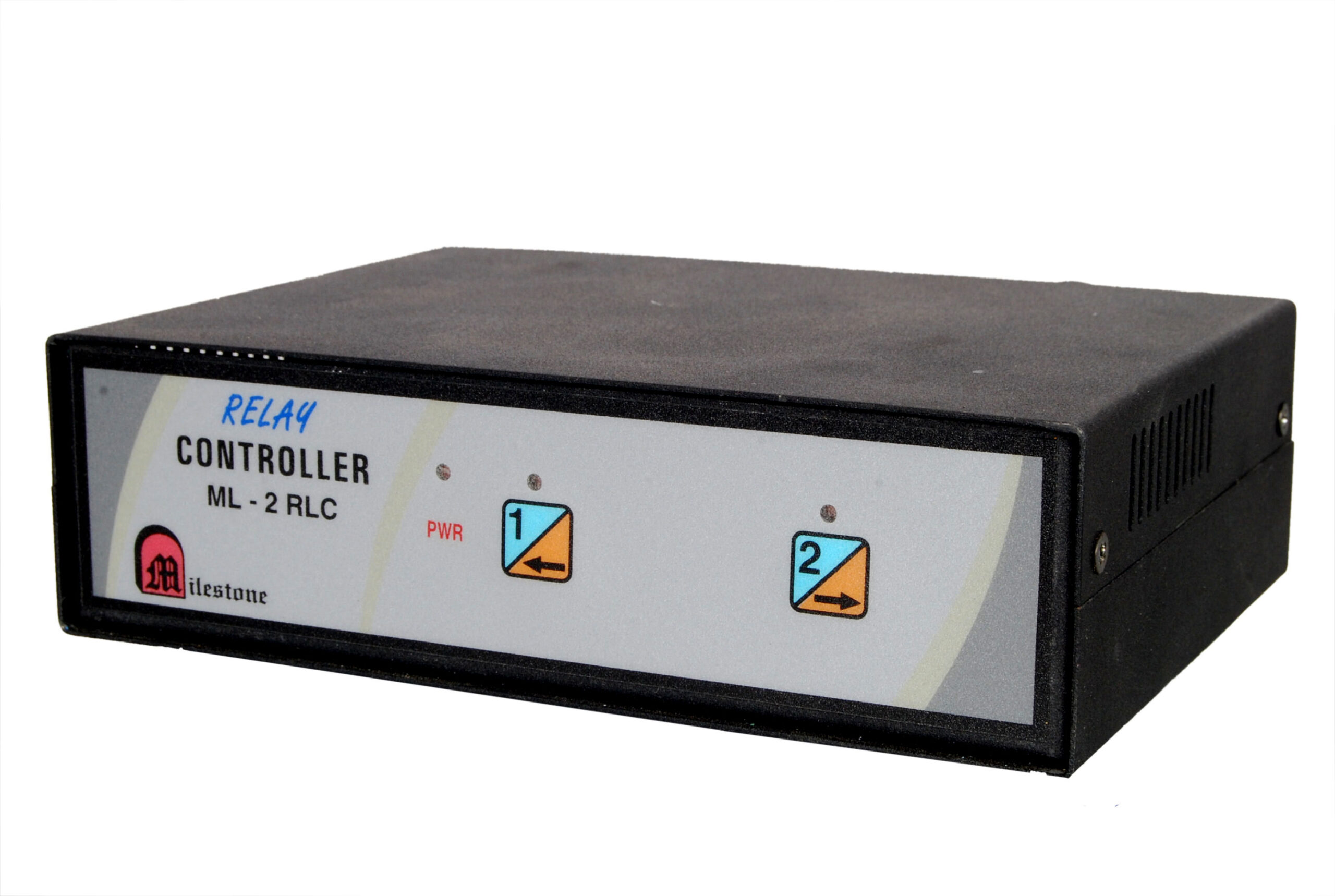
The ML-2RLC is a 2-relay controller that enables control of 230V electric appliances from a single location. It supports local keypad, remote keypad, contact closure, and RS232C interface operation, with battery-backed relay status memory and optical isolation between the RS232C port and relay outputs.
- 1 composite AV input distributed to 4 independent AV outputs
- Audio and video signals transmitted together without delay or mismatch
- Each output individually managed and amplified for consistent signal strength
- Video bandwidth up to 90 MHz (-3dB) with 75-ohm impedance matching
- Rugged metal enclosure with captive screw audio connectors for fixed installations
Max Resolution
1080p Full HD
Audio Input
Stereo Analogue
Output
Single HDMI
- In-house manufactured
- 2,000+ clients served
Product Overview
What the ML-2RLC delivers
The ML-2RLC is a 2-relay controller designed to allow centralised control of 230V electric appliances from a single point. It is intended for environments where switching of load devices must be performed remotely or via an automated interface, without the need for a person to be physically present at each device.
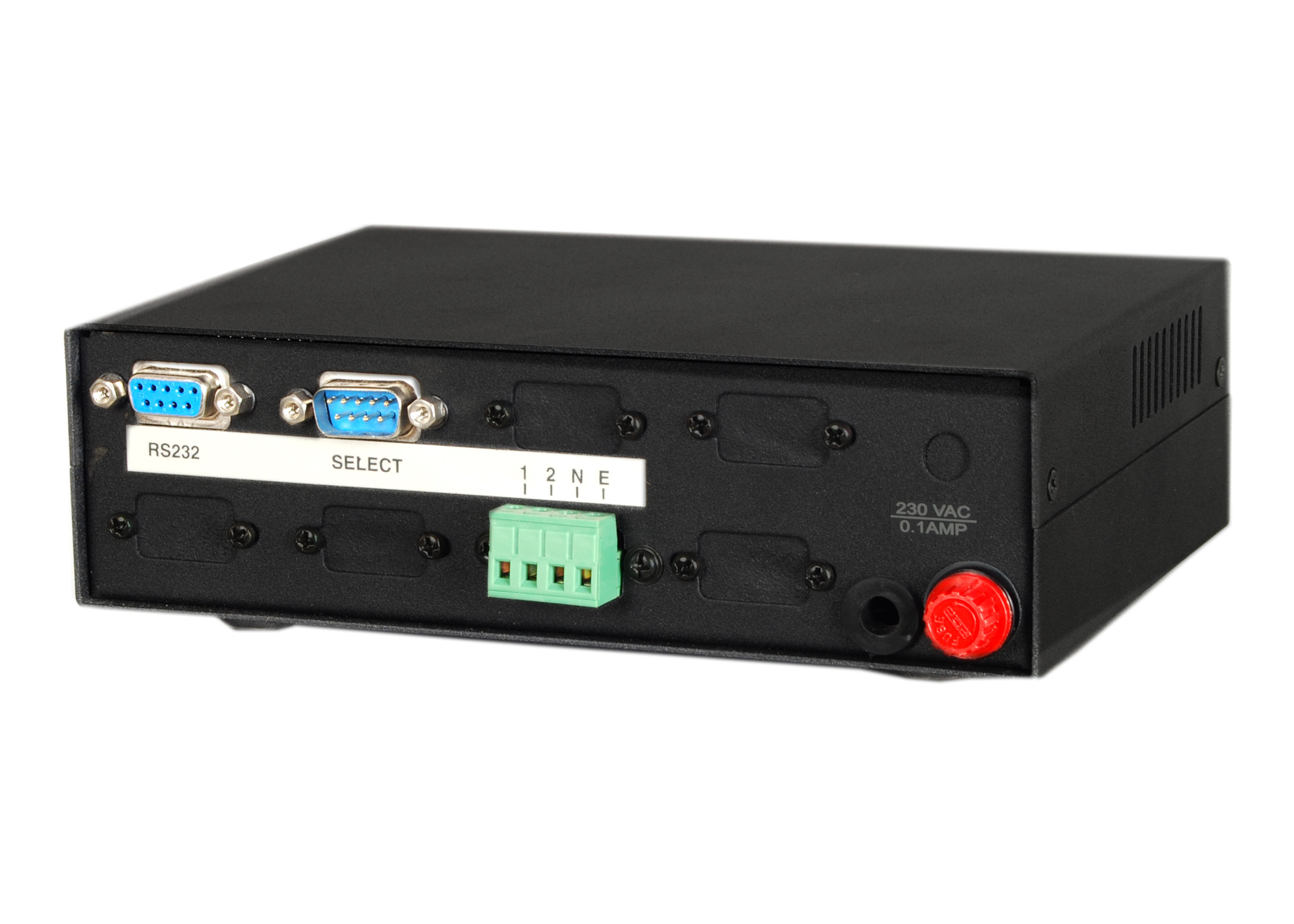
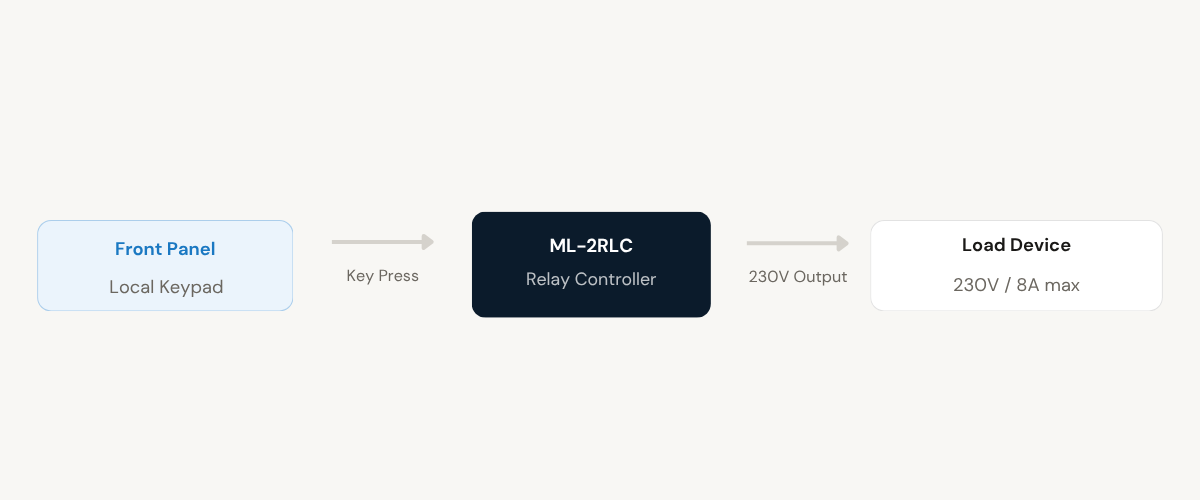
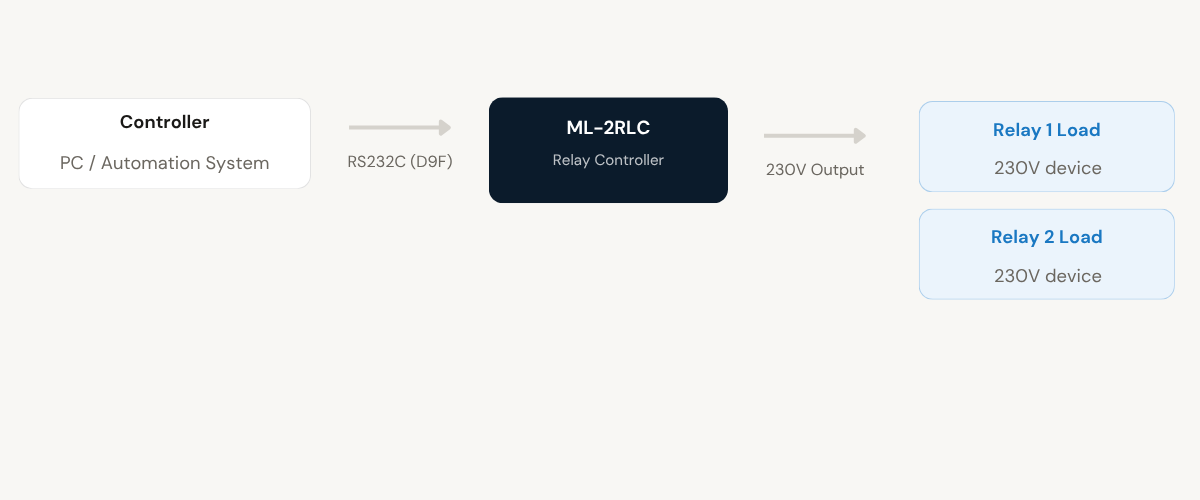
The unit supports multiple control methods. The front panel local keypad allows manual operation, while the rear-panel D9 male connector enables a remote keypad or contact closure device to operate the relays from a distance of up to 50 metres. For system-level integration, RS232C control is available via a D9 female connector on the rear panel, with optional RS422/RS485 and IR/RF remote keypad interfaces also supported.
Each relay can be operated independently in normal mode, or configured as an exclusive pair using the DIP switch. In exclusive mode, the two relays work in a paired arrangement where switching one relay ON automatically forces the other OFF. This configuration is designed for motor control applications, where the two relay outputs correspond to the forward and reverse directions of a motor.
Battery-backed memory ensures that the last selected relay status is retained when power is removed and restored, avoiding the need to manually reinstate relay states after a power cycle. RS232C and relay circuits are optically isolated from one another, providing a degree of protection between control and load circuits.
No. of Relays
Need a quote?
Our team responds within 24 hours with a tailored quote for your project or bulk order.
Key Features
Flexible, isolated relay switching for 230V loads
Multiple control interfaces, optical isolation, exclusive relay pairing, and battery-backed status memory in a single rack-mountable unit.
Multiple Control Interfaces
The ML-2RLC accepts relay commands through several input methods, enabling integration into manual, remote, and automated control environments without requiring additional switching hardware.
- Individual local keypad on front panel
- Remote keypad or contact closure via D9 male connector, up to 50 metres
- RS232C interface via D9 female connector
- Optional RS422/RS485 and IR/RF remote keypad interfaces
Normal and Exclusive Relay Modes
Each relay pair can be set to operate independently or in exclusive mode using the onboard DIP switch. Exclusive mode ensures mutually exclusive operation between the two relay outputs, which is specifically intended for motor forward/reverse control.
- Normal mode: Relay 1 and Relay 2 operate as independent outputs
- Exclusive mode: switching one relay ON forces the other OFF
- Designed for motor operation with dedicated F (forward) and L (reverse) contacts
Battery-Backed Status Memory
The controller stores the last selected relay status in battery-backed memory. When power is restored after an outage, all relays return to the state they were in before power was removed, eliminating the need for manual reinstatement after each power cycle.
- Relay status preserved across power cycles
- No manual relay reinstatement required after power restoration
Optical Isolation
The RS232C interface and relay output circuits are optically isolated from one another. This separation reduces the risk of interference or damage between the control electronics and the 230V load circuits, providing a safer and more reliable installation in sensitive environments.
- RS232C interface electrically isolated from relay outputs
- Protects control circuitry from load-side transients
RS232C Command Control
When operated via RS232C, each relay can be individually switched ON or OFF using simple ASCII commands. Group commands for switching all relays simultaneously, or targeting specific relay pairs, are also supported. Up to 48 relays across 6 units can be managed through a single RS232C controller using the unit identifier code.
- 9600 baud, 8-bit, 1 stop bit, no parity
- Individual ON/OFF, All ON, All OFF, and pair commands supported
- Unit identifier DIP switch allows multi-unit operation on a single RS232C line
Front Keypad Toggle and Momentary Modes
DIP switch 8 sets the front panel keypad behaviour. In toggle mode, each key press alternates the relay between ON and OFF. In momentary mode, the relay is held ON only while the key is pressed and returns to OFF on release. In momentary mode, all relays are also set to OFF at power-on.
- Toggle mode: press to switch ON or OFF
- Momentary mode: relay active only while key is held
- Holding any key for more than 2 seconds turns all relays OFF
Installation
Local keypad, remote contact closure, or RS232C
The ML-2RLC supports three primary installation and control configurations. Select the operating mode using the rear-panel Manual/RS232 select switch before connecting the relevant interface.
01
Manual Mode via Local or Remote Keypad
Set the rear-panel select switch to Manual mode. In this configuration, pressing a key on the front panel toggles the corresponding relay output. For remote operation, connect Milestone's remote keypad or a third-party contact closure device to the D9 male connector on the rear panel. Short the appropriate pin to pin 9 (common GND) to trigger the corresponding relay. This remote connection supports cable runs of up to 50 metres.
02
RS232C Interface Mode
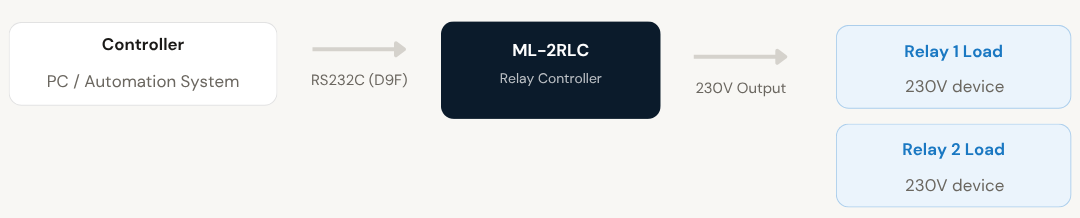
Set the rear-panel select switch to RS232 mode. Connect the controlling device to the D9 female RS232C connector using pin 3 (Rx) and pin 5 (GND). Communication parameters are 9600 baud, 8-bit data, 1 stop bit, no parity. ASCII commands are used to switch individual relays ON or OFF, switch all relays together, or control relay pairs. The unit identifier code set via DIP switches 5, 6, and 7 allows multiple units to be addressed over a single RS232C line.
03
Exclusive Mode Wiring for Motor Control
Set DIP switch 1 to ON to activate exclusive mode for the Relay 1 and Relay 2 pair. Use the 4-pin captive screw connector for the motor. Connect the motor common wire to N, the forward wire to F, the reverse wire to L, and earth to E. Press key 1 to drive the motor in reverse and key 2 to drive it forward. Do not use the Relay 2 separate connector when a motor is connected in exclusive mode.
04
DIP Switch Configuration
The 8-bit DIP switch block controls operating modes. Bits 1 to 4 select Normal or Exclusive mode for each relay pair. Bits 5, 6, and 7 set the unit identifier code for RS232C multi-unit addressing. Bit 8 selects between Toggle mode (OFF) and Momentary mode (ON) for the front panel keypad. Verify DIP switch settings before powering on the unit to ensure the correct operating mode is active.

Where the ML-2RLC performs
Designed for installations where 230V load devices must be switched reliably from a remote or automated control point, across a variety of commercial, industrial, and AV environments.
AV System Power Sequencing
Control the power state of projectors, displays, amplifiers, or other 230V AV equipment in presentation rooms and boardrooms. Relay outputs can be toggled via the local keypad or through RS232C commands from an AV control system.
Lighting Control
Switch 230V lighting circuits in offices, auditoriums, or event spaces from a centralised control point. The remote contact closure input allows a wall-mounted switch to operate the relay from up to 50 metres away without additional controllers.
Motor Forward/Reverse Control
The exclusive relay mode pairs Relay 1 and Relay 2 for direct motor control, with dedicated forward and reverse output contacts. This makes the ML-2RLC suitable for driving small 230V motors such as those used in conveyors, gates, blinds, or actuators.
Building Automation Integration
Integrate with building management systems via RS232C to provide relay-switched control of 230V loads such as HVAC ancillary equipment, indicator panels, or alarm outputs. Up to 48 relays can be managed across 6 units on a single RS232C controller using unit identifier codes.
Conference Room and Boardroom Control
Provide presenters or operators with keypad-based switching of room equipment without exposing power distribution panels. The remote keypad option allows a compact wall-mounted control point to operate loads from a convenient position within the room.
Educational and Training Facilities
Allow instructors to switch equipment in labs or training rooms from a single control point, with the option to automate switching sequences via RS232C from a room control computer. The battery-backed memory ensures equipment states are restored correctly after power interruptions.
Full specification sheet
- Relay Output
- Power
- Control Interfaces
- DIP Switch Settings
- Multi-Unit Operation
- Memory and Isolation
- Physical
FAQs about the ML-2RLC 2 Relay Controller
What is the ML-2RLC used for?
The ML-2RLC is a 2-relay controller that allows a person to switch 230V electric appliances remotely from a single control point. It is intended for use in environments where appliances or load devices need to be switched ON or OFF without physical access to each device, either through a manual keypad, a remote contact closure, or an RS232C command interface.
What control methods does the ML-2RLC support?
The ML-2RLC supports four control methods: individual local keypad on the front panel, remote keypad or contact closure connected to the rear-panel D9 male connector, RS232C interface via the rear-panel D9 female connector, and optionally RS422/RS485 or IR/RF remote keypad. The rear-panel Manual/RS232 select switch determines which mode is active.
What is exclusive relay mode and when should it be used?
Exclusive mode is a DIP switch setting that makes Relay 1 and Relay 2 operate as a mutually exclusive pair. When one relay is switched ON, the other is forced OFF automatically. This mode is specifically designed for motor control applications where the two relay outputs correspond to the forward and reverse directions of a 230V motor. In this mode, the 4-pin captive screw connector is used, with dedicated terminals for forward (F), reverse (L), neutral (N), and earth (E).
What happens to relay states when power is switched off?
The ML-2RLC uses battery-backed memory to store the last selected relay status. When power is restored after being switched off or lost, all relays return to the state they were in immediately before the power was removed. This means there is no need to manually reinstate relay states after each power cycle. The only exception is when DIP switch 8 is set to ON (momentary mode), in which case all relays are initialised to OFF at power-on.
How are RS232C commands structured for the ML-2RLC?
RS232C commands consist of a relay number or group character followed by the unit identifier character set via DIP switches 5, 6, and 7. For example, to turn Relay 1 ON on a unit set to identifier “!”, send the command “1!”. To turn Relay 1 OFF, send “a!”. To turn all relays OFF, send “0!”. To turn all relays ON, send “O!”. Communication is at 9600 baud, 8-bit data, 1 stop bit, no parity. The “%” character can be used in place of the unit identifier to override the DIP switch setting.
Can multiple ML-2RLC units be controlled from a single RS232C port?
Yes. The unit identifier code, set using DIP switches 5, 6, and 7, allows multiple units to be addressed independently over a single RS232C controller. Each unit is assigned a unique identifier character (!, #, @, $, &, or ;), and commands are addressed to a specific unit by appending its identifier to the relay command. This allows up to 6 units with 8 relays each, totalling 48 relay outputs, to be managed from one RS232C port.
How far away can the remote keypad or contact closure device be installed?
The remote keypad or contact closure device connected to the rear-panel D9 male connector can be located up to 50 metres from the ML-2RLC unit. The relay is operated by shorting the relevant pin on the D9 connector to pin 9, which is the common ground. Milestone’s own remote keypad is supported, as is any third-party contact closure device that provides a simple switch contact between the relay pin and ground.
Is the RS232C interface electrically isolated from the relay outputs?
Yes. The RS232C interface circuitry and the relay output circuits are optically isolated from one another within the ML-2RLC. This electrical separation reduces the risk of load-side transients or voltage spikes from the 230V circuit affecting the control electronics, providing a safer and more reliable operating environment for both the controller and the connected RS232C host device.
Products you may also need
Ready to order or have a specific requirement?
Our team responds within 24 hours. Bulk pricing, custom solutions, and pan-India delivery are available. Talk to an engineer directly about your setup.